Student innovation
SeriScope: A Low-Cost Edge-AI System for Fertility and Disease Assessment of Tassar Silkworm Eggs
An offline, low-cost Edge-AI tool that reads microscope images to detect pebrine disease and assess egg fertility in tassar silkworm grainages.
The problem
Pebrine, caused by Nosema bombycis, is one of the most harmful threats to sericulture. Diagnosing it means checking moth body fluid under a microscope by hand, which is slow, needs skilled people and is open to human error, so infected eggs can reach farmers.
Objective
Give grainages a fast, affordable diagnosis tool that works offline on small embedded hardware, so pebrine can be caught early and egg fertility assessed without a specialist or an internet connection.
Project story
The team collected more than 1,400 real-world microscopy examples from tassar grainages in sericulture regions and trained five classification models on them. On the test set the best PyTorch model, VGG16, reached 98.68% accuracy, and the ONNX versions ran on CPU at about 15 to 47 ms per image.
The team also built a non-CNN pipeline using texture and shape features. It is easier to interpret and needs less computing power, which suits low-power field devices.
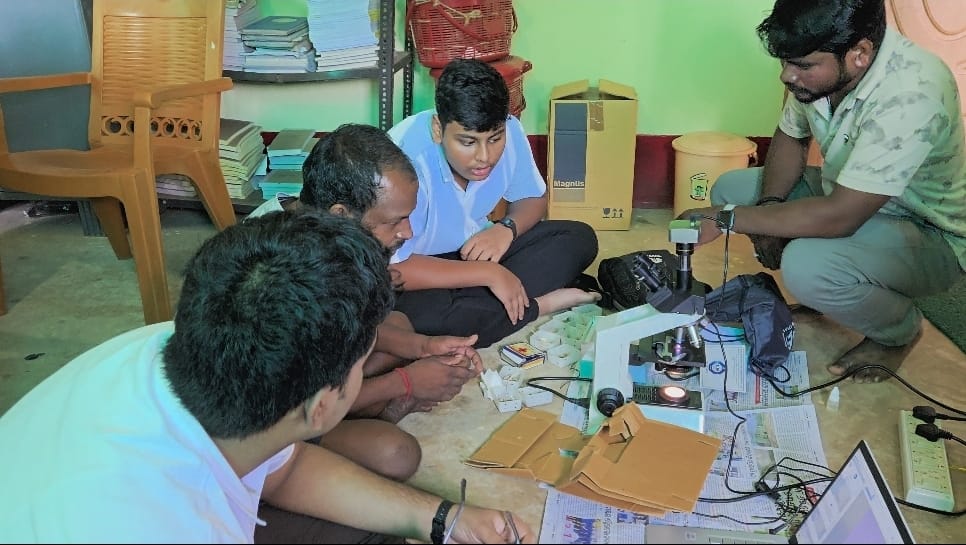
Field visits to the Sukinda Silk Farm and grainages gave the team real samples and expert guidance. Next steps under exploration include fluorescence microscopy and DNA-based confirmation such as PCR or LAMP.
SeriScope won a Gold Medal at the IRIS National Fair, was selected for Team India at ISEF 2026 in Phoenix, USA, and received a Special Award at ISEF 2026.
How it works
A microscope camera captures images of the sample. The images are resized and normalised, then classified as bacteria, non-pebrine or pebrine by trained models that run offline on a small device. A second, lightweight pipeline based on texture and shape features gives an explainable cross-check. The live feed, predicted class and confidence score are shown on the SeriScope interface.
Meet the team


Selected achievements
- AwardGold Medal WinnerInitiative for Research & Innovation in STEM (IRIS) National Fair, Cohort 12026
- AwardSpecial Award by Zydus Pharmaceuticals (USA) Inc. (US$1,500)Regeneron ISEF 2026, Phoenix, USA2026
- SelectionSelected for Team IndiaRegeneron ISEF 2026, Phoenix, USA2026